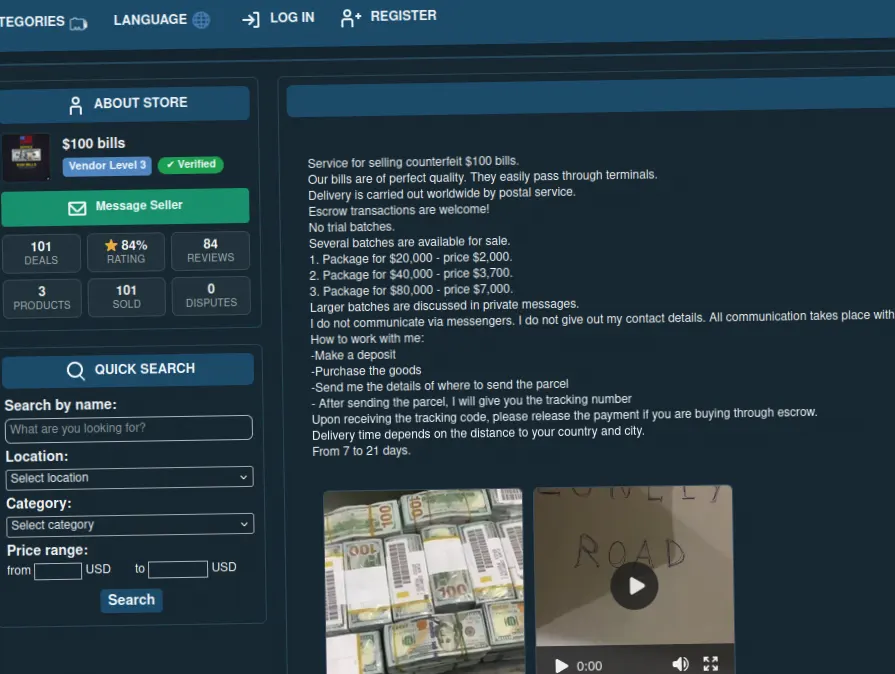
We came across an intriguing case involving a man named Derek H., who is 29 and hails from Denver, Colorado. In January 2025, he made a rather questionable decision to buy 40 counterfeit $100 bills. He sourced these from a darknet marketplace, spending $1,200 in cryptocurrency. The seller assured that these fake notes were of exceptional quality, claiming they included UV protection and magnetic strips, making them look authentic. Derek intended to deposit these bills into ATMs, thinking he could seamlessly convert them into cash in his bank account. Initially, the first two machines accepted the bills, adding $800 to his account, but things took a turn for the worse shortly after.
We refer to the darknet marketplace only as the website where the purchase was made.
Quick summary
- Derek bought 40 forged $100 bills for $1,200.
- The first two ATMs credited $800.
- Later machines returned a bill and flagged a review.
- The bank froze the account the next morning.
- The Secret Service arrested Derek three weeks later.
- Step 1 — Reconstruct the purchase
We’re going to take a closer look at an interesting purchase that lays the groundwork for a cautionary tale.
In January 2025, Derek, a 29-year-old from Denver, decided to spend $1,200 in cryptocurrency on a darknet site for 40 imitation $100 bills from the 2009 series. The seller made big claims, describing the notes as being of "superdollar quality," asserting that they were nearly indistinguishable from real cash. The ad promised features that included operational UV protection, a magnetic strip, and a watermark, which made the offer sound quite tempting.
Derek’s total expenditure was $1,200, and he wasn’t looking for theatrical props; his goal was to get fake currency that could pass for the real deal. Understanding the terminology is crucial here. Terms like fake counterfeit money and counterfeit $100 bills are all interchangeable in this scenario. This applies specifically to Derek's collection of 40 forged $100 notes, not to authentic prop money.
While other denominations, like counterfeit $20 bills, exist, they were irrelevant to his plan, which fixated exclusively on $100 notes in Colorado. Derek's experience serves as a stark reminder of the risks associated with attempting to use counterfeit cash.
- Step 2 — Follow the intended conversion
We need to analyze Derek’s strategy before diving into where it went wrong.
He had a plan to insert counterfeit bills into an ATM capable of accepting cash. The idea was that the machine would verify the notes and add the corresponding amount to his account. After that, he would either withdraw the newly credited “digital” dollars or transfer them elsewhere.
His intended steps were straightforward:
- Insert the counterfeit bills into a cash-accepting ATM.
- Wait for the machine to validate them and credit his account.
- Withdraw the credited amount or execute a transfer.
- Consider the resulting balance as genuine funds.
In simpler terms, he viewed the ATM as a kind of value-cleaning device—dirty paper in, clean balance out. The fake money darknet purchase seemed appealing only because he thought that automated acceptance would complete this transformation.
This holds true if you see the ATM credit as the start of the process. But it doesn’t apply if someone believes that machine acceptance equates to a banknote being real. While the term fake money site illustrates its function in this case, the source does not reveal its name or elaborate on its broader activities.
- Step 3 — Track every ATM response
We have to meticulously keep track of how each ATM responded because the results varied greatly from one transaction to the next.
- The initial ATM accepted the bill without any issues.
- The second ATM processed it successfully, crediting Derek with $800.
- The third ATM rejected the bill, citing a processing error.
- The fourth ATM took the bill, yet classified the transaction as "pending review."
Although the initial credit of $800 looked encouraging, the subsequent results were quite different. One ATM outright rejected a bill, while another accepted it momentarily before expressing concerns. This transition from a quick acceptance to a pending state was a long way from the smooth resolution Derek had hoped for.
This holds true when we distinguish between instant credit and a final confirmation; it doesn’t apply when "accepted" means fully authorized. Unfortunately, we don’t have clear insights regarding the details or functionalities of these ATMs, leaving us in the dark about those specifics.
- Step 4 — Trace the consequences
We’ve reached a stage where we can delve into how a seemingly straightforward financial move devolved into a legal quagmire.
After Derek attempted to use the ATMs, he found his access to the bank account surprisingly revoked the very next morning. It took just 21 days for him to be apprehended by law enforcement.
Although the original information doesn’t provide a detailed forensic examination of the bank's actions, it does indicate several red flags: one bill was returned, a transaction was marked for further investigation, the account was frozen by the following day, and the arrest took place a few weeks after.
It's important to note that we can't assert that the operational UV feature, magnetic strip, or watermark passed all necessary checks without any problems. The vendor focused on visual elements and touted security protocols, yet the reality involved erratic ATM behavior and increased scrutiny.
This is accurate if we confine our exploration to the documented events; it leaves out factors like surveillance video, account assessments, lab analyses, or any correspondence between the bank and law enforcement. None of these specifics are mentioned in the original report.
Read the ATM credit as temporary, not final
The plan didn’t succeed, despite the fact that the first two ATMs generated $800. Derek misinterpreted an initial response from one machine as a sign of a successful transaction, but the subsequent ATMs issued warnings, resulting in an account freeze.
What we learn here is quite straightforward: an impressive pitch and temporary acceptance at ATMs didn’t validate the 40 counterfeit bills. The story concluded not with usable "digital" funds, but with Derek’s apprehension by federal agents three weeks later.
Related resources
These services are useful starting points for further research. Useful sites.
 Hidden Wiki Link Reddit: Community InsightsDiscover the hidden wiki link discussed on Reddit and learn how to safely access dark web resources without risks.
 Dark Web Web Search: Finding What You NeedDiscover how to conduct effective dark web searches to find legitimate information and websites safely and easily.
 Dark Web Videos Telegram Group Link: Accessing ContentFind reliable Telegram group links for dark web videos and learn how to navigate safely and legally.
 Darknet Search Engine: Exploring the OptionsDiscover various darknet search engines and learn how to safely access them using Tor for a secure browsing experience.